Sidewalk Birthday Prayer

Merry and I have been friends since seminary days. From the first day I met her I was a big fan. She ate artichokes, worked in a community sheltered workshop, and was a woman seminarian. She had spent a college-year studying and traveling in Europe. I wanted to be an assertive, risk-taking woman like she was.

Throughout the years of our friendship, Merry has been a mentor and a role model. She taught me to make barley rieska bread, introduced me to 12-step spirituality, and gave me one of my favorite sayings: “If it’s worth doing, it’s worth doing poorly.” My default attitude is to never try anything I don’t think I’ll do extremely well. Merry’s adage has given me permission to try things just because they’re interesting, fun, or worthy–not necessarily because I’ll be good at them. She helped to free me from the tyranny of perfectionism.

So Merry, here’s your poor excuse for a birthday card. If you were hoping for something a little more elegant from me, you should have kept your “worth-doing” wisdom to yourself. But then you never would have gotten a card at all. xoxo


Graph-Paper Gratitude Prayer

This is a gratitude prayer for a group of friends I’ve known for thirty years. I am so blessed by their long-time and long-distant support and prayers–and the impulsive trips to movies and dinners and laughter when I go for visits.

“Just as lotions and fragrance give sensual delight, a sweet friendship refreshes the soul.” (Proverbs 27:9 The Message)

Adelynrood Retreat in June

Adelynrood is a conference and retreat center in the woods of Byfield, MA north of Boston. It was started about a hundred years ago by the Society of the Companions of the Holy Cross. The “companions” are a group of women all around the world who commit their individual lives (wherever they live) to a Rule of Intercessory Prayer, Thanksgiving and Simplicity of Life. Their prayer goals include “the Unity of all God’s People, God’s Mission in the World, and Social Justice.”

On June 15-17, I will lead a Friday to Sunday retreat there. I am grateful for the invitation to be the presenter for the weekend. I like the idea of being at a century-long prayer-soaked place. Below is a description of the retreat.

Praying and Playing — Letting Down Our Guard to Let God In
Program includes: Friday dinner – Sunday lunch:  June 15-17, 2012

Prayer and play both encourage us to let down our guard and become childlike. Praying in Color is an active, meditative, and playful prayer practice that uses pen, paper, and markers to create an entrance into stillness and listening. Participants will learn this versatile prayer practice through intercession and lectio divina. Song, movement, and playful exercises will invite our bodies and spirits into community, prayer and worship. If you have a short attention span and a restless body OR would like to talk to God without words OR are just looking for a new way to let God in, come experience Praying in Color. Absolutely no artistic ability is necessary! Supplies provided.

For more information and to register click here. Sign up and bring a friend.


Good Shepherd Prayer

Today, the fourth Sunday of Easter, is Good Shepherd Sunday on the liturgical calendar. The gospel reading was the familiar words from John 10 (RSV):
11. I am the good shepherd. The good shepherd lays down his life for the sheep. 14. I am the good shepherd; I know my own and my own know me. 

As I started to pray for some people today, the words from John’s Gospel reminded me of the lengths to which Jesus goes to protect and safeguard us.The repetitive curlicues around peoples’ names are like sheep’s wool. We are the sheep and the Good Shepherd loves and surrounds us.

Drawing the simple knotty curves helps me to focus. This is not artwork, but prayer work. A pen and markers in hand keep my eyes and hands busy while my mind and heart are engaged in the prayer.

P.S. My husband says this looks like a dessert tray rather than a bunch of sheep. So to reiterate: No artistic skill is necessary to pray in color.

Praying the Word “Way”

For the gate is narrow and the way is hard, that leads to life, and those who find it are few. (Matthew 7:14 NRSV) • “Teacher, we know that you are true, and teach the way of God, truthfully” (Matthew 22:16 NRSV) • Jesus said to him, “I am the way, and the truth, and the life.” (John 14:6 NRSV)

Following and discerning the Way is twisty, exciting, life-giving, scary, difficult, bumpy, exhilarating, exhausting, tricky, rocky, energizing, enlivening–all of these things–but never boring.

Twentieth century poet W.H. Auden describes it dramatically in his Christmas Oratorio For the Time Being:
He is the Way
Follow Him through the Land of Unlikeness; 
You will see rare beasts, and have unique adventures.


Dogwood Prayer

A dogwood tree in our backyard produced only a handful of blossoms last year. Ten days ago on Easter Sunday hundreds of nascent blossoms appeared on the tree. Today it is in full bloom. The flowers are a luscious color of deep pink with a hint of salmon.

My normal prayers are abstract, unplanned doodles, but I couldn’t resist trying to draw a dogwood blossom. After I finished the prayer I remembered the legend of the dogwood tree and its flower. The four-petaled flower often looks like a cross with indentations or holes at the tip of each blossom. The holes represent the imprint of the nails; the reddish/brown coloring next to the holes symbolizes Jesus’s Blood. In the center of the flower, the green buds look like a crown of thorns.  I guess the shape was an appropriate choice for an Eastertide prayer!


Lenten Calendars–Ideas for the Future

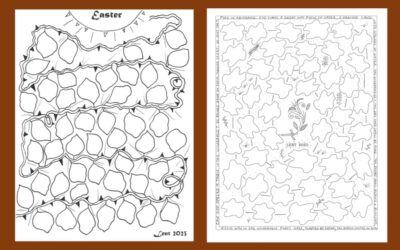
Here are some examples of the way other people used the Lenten calendars.

1. Connie D. read a daily Lenten devotional called Renewed For Life by Henri J. M. Nouwen, published by Creative Communications for the Parish. Each day she chose a meaningful word from the reading and prayed it using her calendar. Even without having read the devotional, I could use the wonderful words on this calendar as a rich vocabulary list for daily reflection.

2. A woman named Ellen wrote this to me:
I used both templates this Lent–printed them on opposite sides of one sheet of heavy  paper. I used the honeycomb one to write names of people  I wanted to remember and pray for, OR a prayer for myself during this  time, enhanced with doodles the way you did.  And I used the regular calendar to list brief gratitudes at the end of each day.  I used colorful markers to do both, and found the practice helpful and life-giving.  

3. Ellen also shared how a friend used the template:
 I also have a friend who used the honeycomb both for herself, as a way to focus each day on a personal discipline she was cultivating, AND one for her 3-year old daughter who colored in a section each day with a different color, while Mom did her own calendar. 

Thanks for the great ideas.

Morels and Mint Tea

Andy and I spent Easter night at the home of longtime clergy friends, Merry and David. When we came downstairs for breakfast on Monday morning, David was busy brewing coffee and Merry was up to culinary mischief. It wasn’t the first time.Thirty years ago I watched in awe as Merry dipped artichoke leaves in melted butter and harvested the teensy amount of tasty flesh with her teeth. At twenty-two, fresh artichokes were not in my vocabulary.

At the sink on this Easter Monday morning, Merry brushed the dirt from some mangy, gnome-like mushrooms. “I found these in my backyard yesterday; I think I’ll sauté them and throw them in the scrambled eggs.”  I love fungus of all sorts–portabellos, criminis, Enokis, shiitakes, white buttons….but I’m wary of eating anything harvested from a pile of damp leaves. So with prayer and terror I swallowed the eggs and the presumed morel mushrooms. They were delicious and edible. Along with some smoked trout and Nova lox, this was a breakfast feast and another culinary first for me from Merry’s kitchen.

With a delicious backyard breakfast in our bellies, the four of us piled into the car and drove south towards Indiana for a day of play. We passed miles of farms and fields. Near the town of Shipshewana we pulled into the driveway of a pristine farm. Cattle grazed in the yard and a youngish woman in a black bonnet was hanging laundry on a clothes line. “This is Daniel and Linda’s* farm,” said Merry. “They are friends of my dad.” (Merry’s dad is 96.)  I’m not much for showing up unannounced at anyone’s house, let alone at a busy Amish couple’s farm. But we jumped out of the car and were greeted with smiles and hugs by Linda. Daniel appeared from the barn and handshakes followed.

After we helped hang the remaining towels and sheets on the line, the six of us went inside the house and sat at a huge table in their large inviting kitchen. A sign on the wall said, “Enter as strangers, leave as friends.” During the following hour, Linda brewed us mint tea from a handful of leaves in her garden. Daniel sat with a child or two on his lap. We talked about ordinary things–gardens, cooking, God, church, children (four of their nine children joined us at the table). What astonished me was the ease with which Daniel and Linda gave up an hour of their busy day. While I was worried about being an intruder and interrupting their work time, they were creating a space for visitation, for community. For their efforts I received an hour of joy and peace. “Do not neglect to show hospitality to strangers, for thereby some have entertained angels unawares.” (Hebrews 13:2 RSV)  Daniel and Linda acted as if they had nothing more important to do than to make us feel at home. Their task for that hour was the radical hospitality of the Gospel. My task was to receive their hospitality and to remember to go and do likewise.

From the first bite of morels and eggs on Easter Monday, I should have known it would be a special day. But I never imagined I would be entertained and treated like an angel by complete strangers.

*Names changed to protect privacy.


Graphite Morel Drawing by Sally Markell

Lenten Calendar 2012 Final

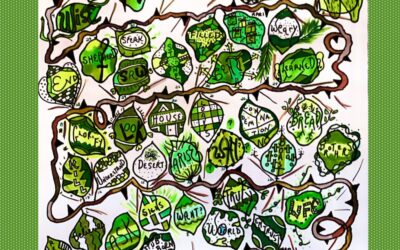
I liked the “behive” template I used this year (or as a friend called it, the “chicken wire”). The six angles in each hexagon provided nice little nooks for arcs, lines, triangles, and a variety of doodle shapes and strokes.

There are so many names  for God. The ones I used are familiar ones–names I have heard before or read in the Bible. Forty-six words is just the beginning of a vocabulary to describe an infinite, everywhere God. Even the sum of thousands of names is inadequate to describe the one who British Catholic hymn writer Bernadette Farrell calls “God Beyond All Names.” I hope my chicken-wire lexicon will continue to expand in all directions. I hope the handful of words I use to address God will become armfuls–names which are now beyond my wildest imagining.


I’d love to hear your experiences with the Lenten calendar–the beehive or the traditional squares.


A Joyous Easter!

“Hallelujah, Christ is risen. The Lord is risen indeed!”

Children in the church I attend bring flowers on Easter Sunday and cover a box-shaped or palm-frond cross with colorful blossoms.The children participate in the transformation of the cross from a tool of hatred to a symbol of victory and love.

This drawing below reminds me of the children’s crosses. When I look at the picture I want to call it Love Crucified, Arose–the title of a resurrection song by Michael Card.

 My friend Connie gave me the stencils (by Pebbles) I used to draw the flowers. She incorporates stencils as part of the way she prays in color. For the art-challenged like I am, this can be a non-threatening way to get started.