
Advent is the season of preparation for the birth of Jesus, the coming of the God into the world as a flesh and blood person on Christmas Day. But, it is not just the four-week waiting period before Christmas in which we prepare spiritually and bake and decorate and buy gifts. It is the dress rehearsal for the way to live every day of the year, to prepare for our daily pilgrimage with God. Christians are called to be Advent people all year. Jesus is our longed-for Savior; but even after Christmas, we still wait for the transformation of the world into the kingdom of God. As a flesh and blood Savior, Jesus calls us to be God’s hands and feet on earth. Jesus invites us to put our feet on the ground and to join in God’s kingdom-building pilgrimage on earth. The practices we take on in Advent teach us to be attentive, one-day-at-a-time pilgrims.
A luscious Advent vocabulary of nouns and verbs sprinkles our church and home conversation during these four weeks: preparation, anticipation, wonder, star, journey, waiting, watching, attention, patience, hope, despair, expectancy, darkness, light, fear, faith, and repentance. These words indicate that something special is about to happen. Some words are about waking up and being alert. Others are paradoxical pairs; they describe the conflicting experiences we have in life. We recite them, read them in Scripture, and sing them during the weeks before Christmas. The words we learn in Advent are the daily, year-round vocabulary of Christians. We wait, hope, watch, hope, fear, trust, listen, anticipate, and repent throughout the year.
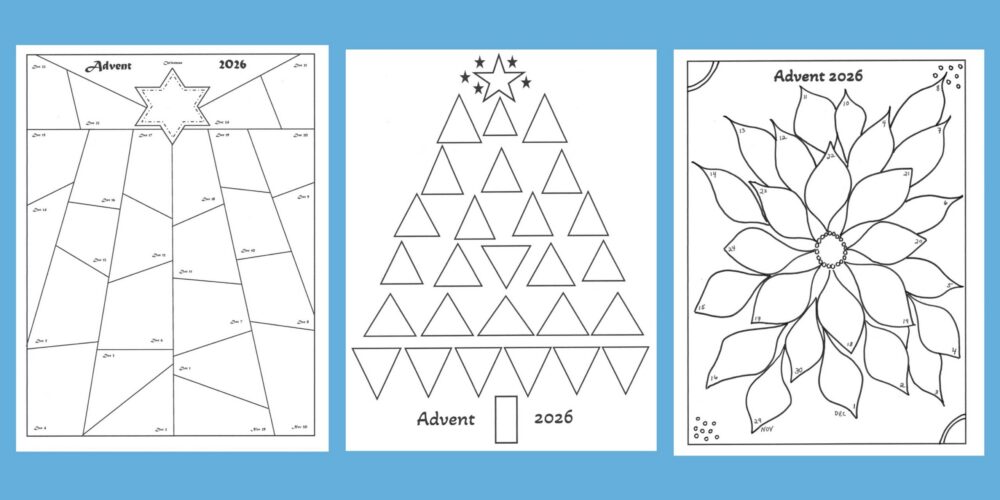
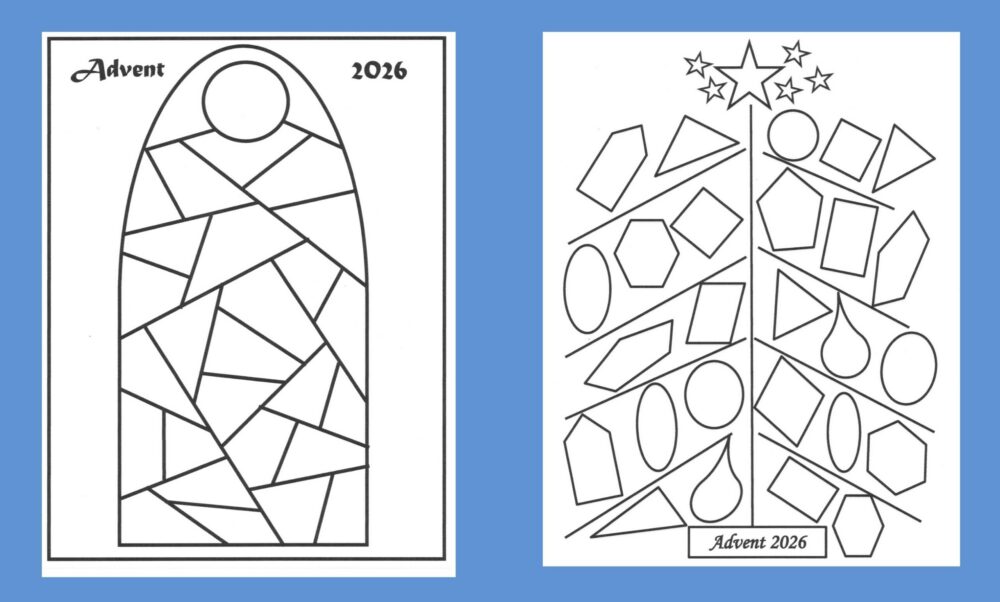
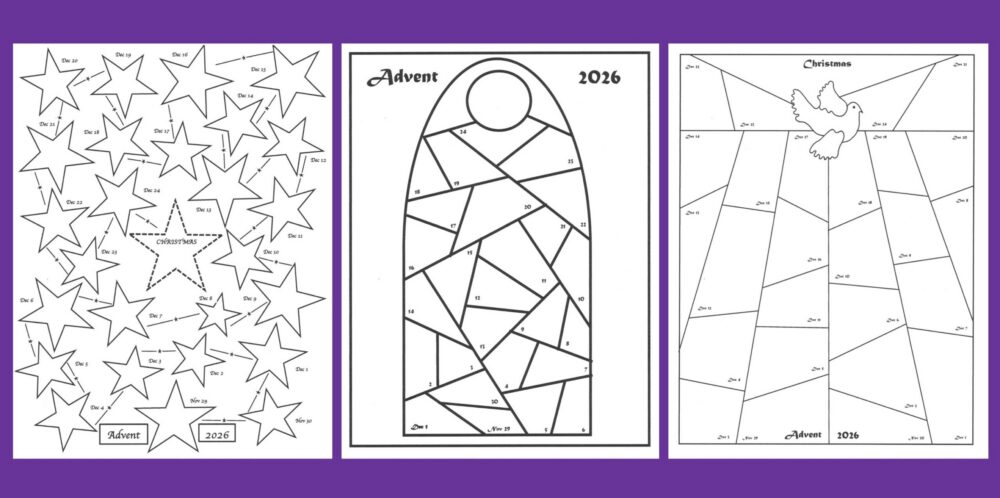
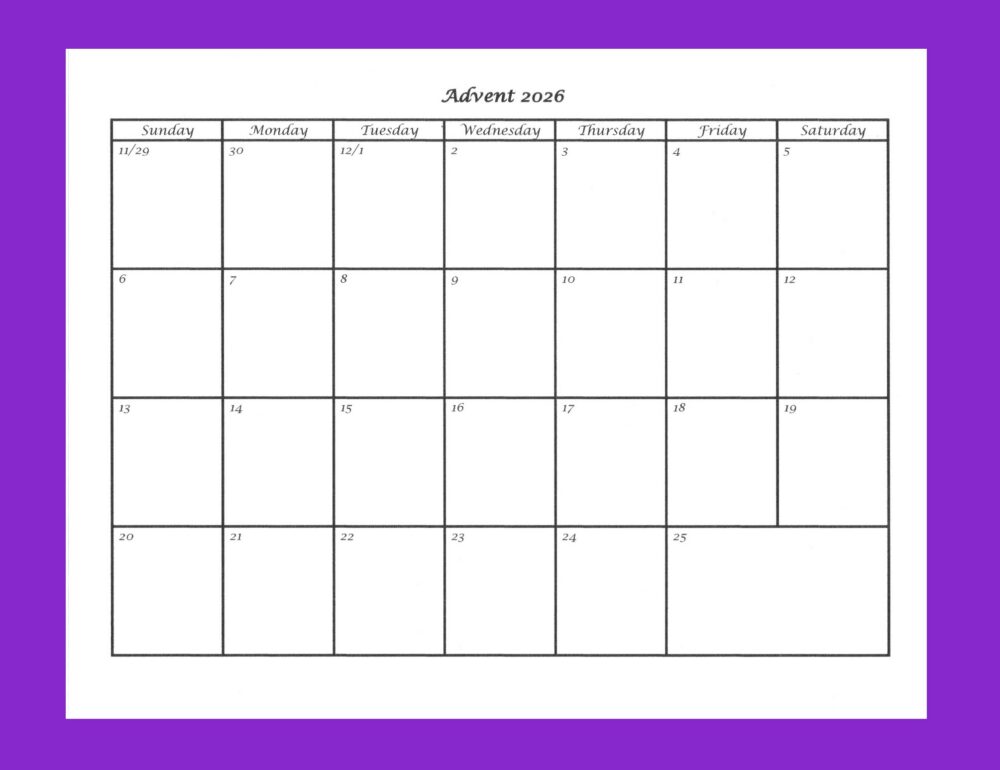
My favorite way to pray and prepare for Christmas is with an Advent calendar. Unlike the store-bought versions, the calendars below have no doors, just blank spaces for each day of Advent. The blank spaces are a daily invitation to build a patchwork of prayers. Each day choose a person to pray for or a word to ponder. Write the name or word in the space and ask God to be part of this daily journey. Then sit with the word and surround it with doodles and color; think of each mark or swath of color as a non-verbal prayer. For me, each day’s offering feels like a little wrapped package to bring to Jesus’s birthday celebration. The word or name is my prayer companion for the day. Creating the Advent calendar helps me to savor each day of Advent. I no longer want Christmas to hurry up and get here! I am content in the waiting and the preparation. When the calendar is finished, the accumulation of daily doodles is a visual record of my Advent journey.
Drawing, writing, or doodling on an Advent calendar template is both a prayerful and playful practice. No artistic skill is necessary. Examples from previous years are at the bottom of the post. Advent starts on November 29 this year, so there are 26 days until Christmas. Scroll down in the post to see the section below called Ways to Pray with the Calendar Templates.
2026 Advent Calendar Templates
Click on the name below the calendars to access the .pdf of the calendar template/s you want. Feel free to share the calendar templates with other individuals or groups. Please Share this post on your social media platforms. These templates are also available on the Resources Page under Advent and Christmas
Some templates have dates; others do not. Follow the designated path to Christmas or choose your own helter-skelter one. Let your imagination loose as you pray and ponder. Add lights, ornaments, stars, greenery, ribbons,.. No need to color within the lines! Add dates if that helps.
Ways to Pray with the Calendar Templates
1) Pray for a person each day. Write their name in the space. Doodle around the name, add color. Think of each stroke of color or each doodled mark (line, dot, arc, spiral…) as a wordless prayer. If words come to you as you draw, pray them–in your mind or write the word on the page. Squeeze words onto the calendar in the shape or along the margins. When you have finished with your daily entry, say “Amen” or recite a short passage of Scripture appropriate to Advent like “The Lord is my light and my salvation.” (Psalm 27:1) This tiny colorful mosaic creates a frame around the person’s name. Return to the calendar each day and let it be a visual reminder to pray for each person again. Add a new person every day.
2) Choose a word from the daily Scripture readings for the season. Here is a website to access the Revised Common Lectionary. The RCL uses the New Revised Standard Version of the Bible, but look at other versions for slightly different language.
3) Choose a word from a book of Advent meditations. Combine your calendar with one of the many wonderful books of daily Advent meditations and reflections. Read the entry for the day and choose a word that jumps out at you. Write the word in the shape and start to doodle and color around it. Marinate in the word. What is it saying to you? What does God have to say to you about the word? Keep a computer or notebook next to your calendar so you can write any insights or “ahas.” Here are several books I have used in the past….
Celebrating Abundance: Devotions for Advent by Walter Brueggemann
Preparing for Christmas with Richard Rohr
Watch for the Light: Readings for Advent and Christmas with many authors
God is in the Manger:Reflections on Advent and Christmas by Dietrich Bonhoeffer
Let Every Heart Prepare: Meditations for Advent and Christmas by Barabara Cawthorne Crafton
Preparing Room: An Advent Companion by Russell J. Levenson Jr.
And a couple of new ones I will explore this year….
Gospel Voices: Advent with Matthew, Mark, Luke, & John by Tina Francis, Jerusalem Jackson Greer, Deon K. Johnson, & Marshall Jolly
Advent Unhurried: Daily Devotions for a Season of Wonder and Stillness by Micha Boyett
4) What are things you love about the seasons of Advent, Christmas, and Epiphany? Candy, cookies, carols, lights, candles, stars, parties, gifts, church services, gifts…? Let these words fill your calendar. Don’t try to be overly spiritual. If “God became flesh and dwelt among us,” we can celebrate the gifts of physicality–even the seemingly unimportant and extravagant ones.
5) Write and ponder an Advent word like prepare, wait, pregnant, hope, watch, darkness, wilderness, longing, light…as you doodle and color. There are dozens of words associated with Advent. When you complete a calendar using these words, it is like having a mini, visual dictionary of the Season.
6) Use the words chosen by #AdventWord. This ministry of Forward Movement offers words for each day and the chance to see how others throughout the world have reflected on the word. Sign up to receive a daily meditation on the word. The finished calendar is a another version of a visual dictionary of important concepts of Advent.
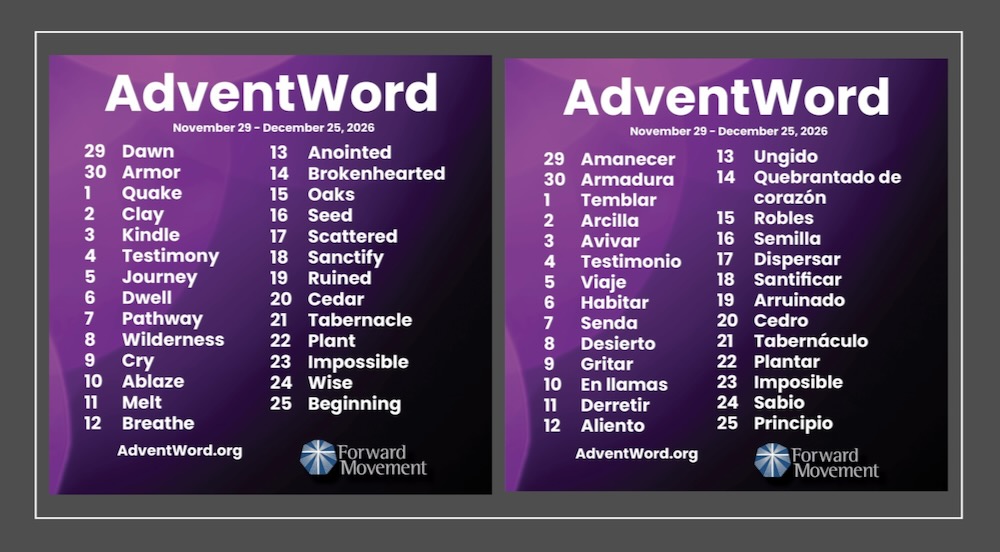
7) Write something you hope for each day. Advent is a season of hope. Choose a word of hope and write it in the space. Let the word fill you as you draw and add color.
8) Celebrate the Women and Men of the Bible. Choose a different person for each day and learn what they did and why they are important to our story and God’s story. As you draw, be quiet and listen to what these people might reveal to you about Jesus and God.
9) Write one of the many names for Jesus in the daily box. Here are a few of the many ways we refer to Jesus: savior, messiah, friend, Prince of Peace, Emmanuel.… Use the Bible, Handel’s Messiah, Christmas carols, and hymns to uncover those names. Pray and ponder how that name for Jesus stirs, affects, annoys, delights, or inspires you.
10) Color and doodle in the space. For smaller children, print the calendar on 11″x17″ paper to create larger spaces. (I do this for myself, too.) Teach them about Advent as a “one day at a time” journey. Light a battery-powered votive candle and give them a quiet, secret place to work.
Examples from Previous Years

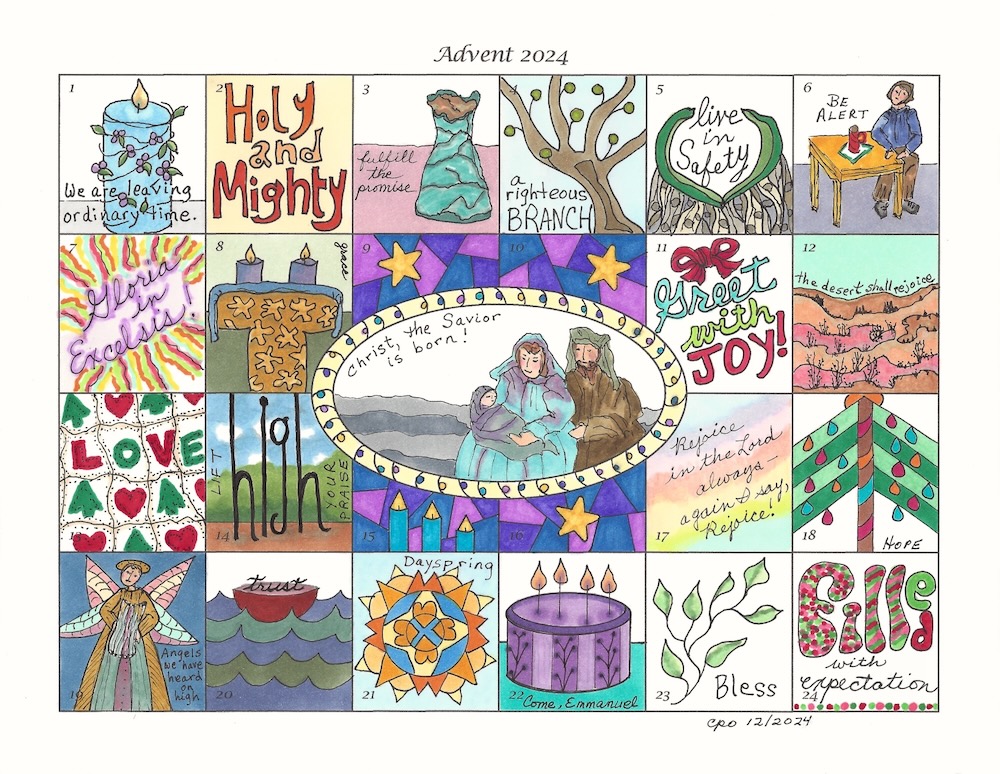


Thanks to Cindy O for her Box Calendar template and for her finished 2024 Calendar.
0 Comments